The Ends of the Book
PSNH: The Ends of the Book: Authors, Readers, Public Spaces A lecture by Matthew Stadler, founder of Publication Studio, on the occasion of Publication Studio New Haven, a one-week project hosted by Beinecke Library and ArtSpace New Haven. Followed by an interview with project coordinator, Timothy Young and an audience Q&A.
New Exhibition: Remembering Shakespeare
Remembering Shakespeare
Wednesday, February 1 – Monday, June 4, 2012
Remembering Shakespeare tells the story of how a playwright and poet in late sixteenth- and early seventeenth-century England came to be remembered as the world’s most venerated author. Curated by David Scott Kastan, George M. Bodman Professor of English at Yale, and Kathryn James, Beinecke Library Curator, the exhibition brings together works from the holdings of Yale University’s Elizabethan Club, Irving S. Gilmore Music Library, Lewis Walpole Library, Yale Center for British Art, and Beinecke Library, in an unprecedented display of one of North America’s finest collections on Shakespeare. Drawing on these extraordinary resources, Remembering Shakespeare offers a unique visual history of how the “Booke” of Shakespeare was made and read, written and remembered, from his lifetime through the present.
This exhibition is part of Shakespeare at Yale, a multi-venued celebration for the spring of 2012 that will display the extraordinary resources that exist at the University for the study and enjoyment of Shakespeare. For more information, visit: Shakespeare at Yale.
New Year’s Greetings
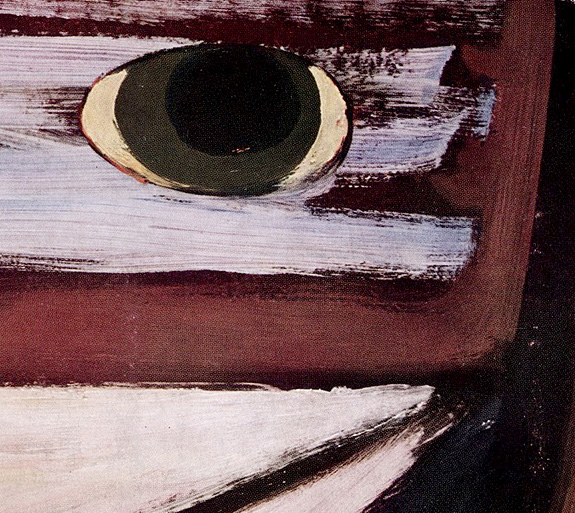
Miguel Covarrubias, Hand painted New Year’s card sent to Carl Van Vechten (Portrait of Rose and Miguel Covarrubias), 1946. From the Carl Van Vechten Papers.
Holiday Greetings
Miguel Covarrubias, Hand painted Christmas card sent to Carl Van Vechten (portrait of Rose and Miguel Covarrubias).
New from the Beinecke Collections: IDA
Ida: A Novel
a new edition, edited by Logan Esdale; published by Yale University Press

Gertrude Stein wanted Ida to be known in two ways: as a novel about a woman in the age of celebrity culture and as a text with its own story to tell. With the publication of this workshop edition of Ida, we have the novel exactly as it was published in 1941, and we also have the full record of its creation. Logan Esdale offers informative critical commentary and judiciously selected archival materials to illuminate Stein’s experience of authorship from the novel’s beginning in early summer 1937, through the various drafts and negotiations with her publisher, to the reviews that greeted the book’s publication. Stein’s careful and systematic preservation of all Ida-related materials for her archive at the Yale University Library was a conscious decision, and an invitation for us to study the complexity of her creative process.
Gertrude Stein (1874–1946) was born in Allegheny, PA, of German-Jewish immigrants. She moved to Paris in 1903 and lived in France for the rest of her life. She published Ida: A Novel in 1941, eight years after she became famous for her best-selling Autobiography of Alice B. Toklas. Logan Esdale teaches at California State University, Long Beach.
Beinecke Collections: Gertrude Stein and Alice B. Toklas Papers Finding Aid (YCAL MSS 76); Gertrude Stein and Alice B. Toklas Papers Image Guide
Grimaces (changeable)
A paper toy from France that uses two wheels and a sliding strip to combine different facial features.
“Gd. cirque des folies élastiques intermède des grimaces d’O'Gus’” (circa 1900?)
REBINDING BLOW-OUT

REBINDING PARTY
Saturday, November 19 from 12:00 – 5:00:
“Five Buck Book Binding Blow-Out!”
Bring in your old, falling-apart paperbacks or a book whose cover doesn’t suit you, and get it rebound into a sturdy manila bound edition. $5/rebind.
at PSNH Pop-Up Shop
196 College Street, New Haven, CT 06510
***
Publication Studio comes to the Elm City to redefine the social life of the book
A One-week Residency in the Coop Center for Creativity
November 14 – 19, 2011
MORE Information: PSNH

PSNH Friday

FRIDAY at PSNH
(196 College Street, New Haven, CT 06510)
POP-UP SHOP OPEN HOURS
11:00 – 6:00
PUBLICATION DEMONSTRATION
(refreshments served)
1:00 – 2:00
PSNH PUBLIC LECTURE
Diana Balmori, internationally renowned landscape and urban designer,
will speak at the launch of Publication Studio’s facsimile edition of her Moleskin Diaries
Friday, November 18, 2011
6:00 PM – 7:30 PM
Free and open to the public
***
Publication Studio comes to the Elm City to redefine the social life of the book
A One-week Residency in the Coop Center for Creativity
November 14 – 19, 2011
MORE Information: PSNH

TODAY @ PSNH

THURSDAY at PSNH
(196 College Street, New Haven, CT 06510)
POP-UP SHOP OPEN HOURS
11:00 – 6:00
PUBLICATION DEMONSTRATION
(refreshments served)
1:00 – 2:00
PSNH PUBLIC LECTURE
Matthew Stadler, founder of Publication Studio
“The Ends of the Book: Authors, Readers, Public Spaces”
Thursday, November 17, 4:00 – 5:30.
Location: Beinecke Rare Book and Manuscript Library,
121 Wall Street, New Haven, CT
Free and open to the public
***
Publication Studio comes to the Elm City to redefine the social life of the book
A One-week Residency in the Coop Center for Creativity
November 14 – 19, 2011
MORE Information: PSNH

Today at PSNH

WEDNESDAY at PSNH
(196 College Street, New Haven, CT 06510)
POP-UP SHOP OPEN HOURS
11:00 – 6:00
PUBLICATION DEMONSTRATION
(refreshments served)
5:00 – 6:00
Matthew Stadler discusses Print on Demand, Literature, and the World
using 20 images shown for 20 seconds each
6:30pm at Bentara
Bentara is on Orange Street between Chapel and Crown, in downtown New Haven.
***
Publication Studio comes to the Elm City to redefine the social life of the book
A One-week Residency in the Coop Center for Creativity
November 14 – 19, 2011
MORE Information: PSNH

TODAY at PSNH

TUESDAY at PSNH
(196 College Street, New Haven, CT 06510)
POP-UP SHOP OPEN HOURS
11:00 – 6:00
PUBLICATION DEMONSTRATION
(refreshments served)
5:00 – 6:00
PSNH on air
(WNPR CT Public Radio)
CURATOR INTERVIEW: Tim Young talks to Faith Middleton about making and destroying books
3:00pm
***
Publication Studio comes to the Elm City to redefine the social life of the book
A One-week Residency in the Coop Center for Creativity
November 14 – 19, 2011
MORE Information: PSNH

Publication Studio New Haven

Publication Studio comes to the Elm City to redefine the social life of the book.
A One-week Residency in the Coop Center for Creativity
November 14 – 19, 2011
Publication Studio, founded in Portland, Oregon in 2009, is an experiment in sustainable publication that has branched into six independent sibling studios around North America. They print and bind on demand, creating original books quickly with writers and artists they admire. They attend to the social life of the book, cultivating a public that cares and
is engaged.

SCHEDULE OF EVENTS
POP-UP SHOP
196 College Street, New Haven, CT
Hours: 11:00 – 6:00 MTWTF (NOV 14-18); 12-5 SAT (NOV 19)
Demonstrations (open to the public)(refreshments served)
MONDAY, NOV 14 5:00 – 6:00
TUESDAY, NOV 15 5:00 – 6:00
WEDNESDAY, NOV 16 5:00 – 6:00
THURSDAY, NOV 17 1:00 – 2:00
FRIDAY, NOV 18 12:00 – 1:00
Rebinding Party
SATURDAY, NOV 19 12:00 – 5:00
“Five Buck Book Binding Blow-Out”!
Bring in your old, falling-apart paperbacks
or a book whose cover doesn’t suit you,
and get it rebound into a sturdy manila
bound edition. $5/rebind.
PUBLIC LECTURES
Matthew Stadler, founder of Publication Studio
“The Ends of the Book: Authors, Readers, Public Spaces”
Thursday, November 17, 4:00 – 5:30.
Location: Beinecke Rare Book and Manuscript Library,
121 Wall Street, New Haven, CT
Free and open to the public
Diana Balmori, internationally renowned landscape and
urban designer, speaking at the launch of Publication
Studio’s facsimile edition of her Moleskin Diaries.
Friday, November 18: 6:00 – 7:30
Location: 196 College Street, New Haven, CT
Free and open to the public.
Seating is limited, so please arrive early.

Co-sponsored by ArtSpace New Haven and
the Beinecke Rare Book and Manuscript Library
in conjunction with the ArtSpace exhibition
“Library Science”.
The Moon at one Meter
A souvenir from the 1900 Exposition Universelle in Paris, an attraction that allowed visitors to view the moon through a giant telescope.
The imagery for the attraction may be related to the Georges Méliès 1898 film “La Lune à un mètre” (or “The Astronomer’s Dream”)
The Laughable Game of What D’Ye Buy
A set of a popular card game.
This edition published around 1850 by S. Hart & Co. in Philadelphia.
No rules included.
The Grandpère of the MAD Fold-in
Shades of Al Jaffee and MAD Magazine . . .
A printed and folded novelty celebrating Louis XVIII, King of France, 1814-1824.
(Published by J.B. Verzy, circa 1814).
The piece unfolds to spell out the virtues of the man who ruled during the Bourbon Restoration.
Terry Tempest Williams Archive

The Beinecke Rare Book & Manuscript Library has acquired the papers of American writer, poet, naturalist, and activist Terry Tempest Williams.
The author of more than a dozen books including The Secret Language of Snow (1984), Refuge: An Unnatural History of Family and Place (1991), Desert Quartet: An Erotic Landscape (1995), Leap (2000), and Finding Beauty in a Broken World (2008), Williams calls attention to the relationship between our natural environment and social justice. A fierce advocate for freedom of speech, she has testified before Congress on women’s health, committed acts of civil disobedience to protest nuclear testing in Nevada, and served on the boards of The Wilderness Society, the Nature Conservancy’s Utah Chapter, the advisory board of the National Parks and Conservation Association, and on the President’s Council for Sustainable Development. She has collaborated with artists and photographers such as Mary Franks, Emmet Gowin, Richard Misrach, Meridel Rubenstein, and Debra Bloomfield. Her essays on ecological and social issues have appeared in The New Yorker, The New York Times, Orion, and The Progressive. In 2006, The Wilderness Society presented William’s with its Robert Marshall Award, the highest honor the society bestows.
Ms. Williams, whose ancestors were among the earliest Mormon pioneers to settle the valley of the Great Salt Lake, grew up in Utah. She graduated from the University of Utah in 1978 with a degree in English and a minor in biology. She taught on the Navajo reservation at Montezuma Creek, a settlement of fewer than 500 in the southeast corner of Utah, and earned a master’s degree in Environmental Education in 1984. From 1986 through 1996 she worked as curator of education and naturalist in residence at the Utah Museum of Natural History. Ms. Williams, who was recently a Montgomery Fellow at Dartmouth College, is currently the Annie Clark Tanner Fellow in Environmental Humanities at the University of Utah.
“For more than a quarter of a century,” observes George Miles, William Robertson Coe Curator of the Yale Collection of Western Americana, “Terry Tempest Williams has written lyrically about life and the landscape of her Utah home. She has joined with artists, writers, and scientists to increase our appreciation of the wonder and fragility of the world we inhabit and to make us more aware of how the damage we cause that world rebounds to harm us individually and to diminish our society. Her diaries, journals and drafts reveal the extraordinary originality of her creative process while her correspondence with colleagues from around the county illuminates the concerns and efforts of a generation of American environmental activists.”
Ms. Williams’ papers, which comprise 204 boxes, arrived in New Haven this summer. The library’s archivists are organizing the papers and preparing a guide to them, after which they will be opened for consultation.
Questions about the Williams’ papers may be directed to George Miles, Curator of Western Americana, at George.Miles@yale.edu or to Nancy Kuhl, Curator of American Literature for Poetry, at Nancy.Kuhl@yale.edu.
Photo: Terry Tempest Williams
The Game of Medicinal Herbs
Exorcism
The Beinecke Rare Book and Manuscript Library at Yale University has acquired Eugene O’Neill’s “lost” one-act play, “Exorcism” (1919). The play, along with a facsimile of the typescript, will be published in a cloth edition by Yale University Press in February 2012, featuring an introduction by the noted American playwright Edward Albee. The New Yorker has acquired first serial rights and will publish the play in its entirety, with an introduction by theater critic John Lahr, in the magazine’s Fall Books issue, October 17, 2011 (on newsstands October 10). A short video of the actor Tommy Schrider reading from “Exorcism” will be featured onThe New Yorker’s website and iPad application: http://www.newyorker.com/online/blogs/books/2011/10/eugene-oneill-exorcism-reading.html .
“Exorcism,” set in 1912, is based on O’Neill’s suicide attempt from an overdose of veronal in a squalid, Manhattan rooming house. The play premiered at the Provincetown Playhouse in New York City on March 26, 1920. Following a few performances, however, O’Neill chose, abruptly, to cancel the production and to retract and destroy all known copies of the script. O’Neill biographers have speculated that the play, produced as O’Neill’s father was dying, was perhaps too revealing of O’Neill’s own demons and potentially distressing for his parents.
Despite long-held presumptions that the play was irrevocably lost, O’Neill’s second wife, Agnes Boulton, apparently retained a copy of the play, which she gave as a Christmas gift to the writer Philip Yordan after her divorce from O’Neill. Yordan is perhaps best known for his O’Neill-inspired play, and later film, Anna Lucasta, starring an all-black cast. The typescript, with edits and emendations in O’Neill’s own hand, was discovered by a researcher working in Yordan’s papers, together with the original envelope; the label is inscribed, “Something you said you’d like to have / Agnes & Mac” (Morris “Mac” Kaufman was Boulton’s third husband).
O’Neill, a four-time Pulitzer Prize winner and the only American playwright to receive the Nobel Prize for literature (1936), returned to many of the issues that surface in “Exorcism” in his heavily autobiographical play Long Day’s Journey into Night, published posthumously in 1956 and considered to be his masterpiece. The discovery of “Exorcism,” after ninety years, adds significantly to O’Neill’s biography, intimating the overwhelming role that suicide would take in his personal life along with the issue’s influence and impact on his work. The play also marks a pivotal moment in O’Neill’s prolific career, providing further insight into the later works for which he is now revered.
The Beinecke Rare Book and Manuscript Library is the principal repository for the Eugene O’Neill Papers. A detailed description of the papers is available online:Eugene O’Neill Papers Finding Aid (YCAL MSS 123). Some materials from the collection can be viewed online: Eugene O’Neill Papers Image Guide. Related materials and collections may be located using the Beiencke Library’s various research tools: Guide to Research Tools.
For inquiries about the play, or the Eugene O’Neill Papers, please contact Louise Bernard (louise.bernard@yale.edu<mailto:louise.bernard@yale.edu>), Curator of the Yale Collection of American Literature for Prose and Drama, Beinecke Rare Book and Manuscript Library.
For inquiries about the play’s publication in book form this February, please contact Brenda King (brenda.king@yale.edu<https://connect.yale.edu/owa/redir.aspx?C=73c3409735984d659ba72031b6fc15e7&URL=mailto%3abrenda.king%40yale.edu>), Publicity Director, Yale University Press.
Image: Photograph of Eugene O’Neill, inscribed to his son [1927].
Centroid envy
A scrapbook of original designs and proof prints for early Victorian bindings done by R. A. Harrison, ca. 1840s.
Along with sketches for roundels and decorative borders, product labels, and a caricature, are a number of proof sheets for bindings, that retain, remarkably, their intense colors, making available to bibliographers for this period of book production, some of the most faithful hues (which can be described using the Centroid Color Chart).


leave a comment